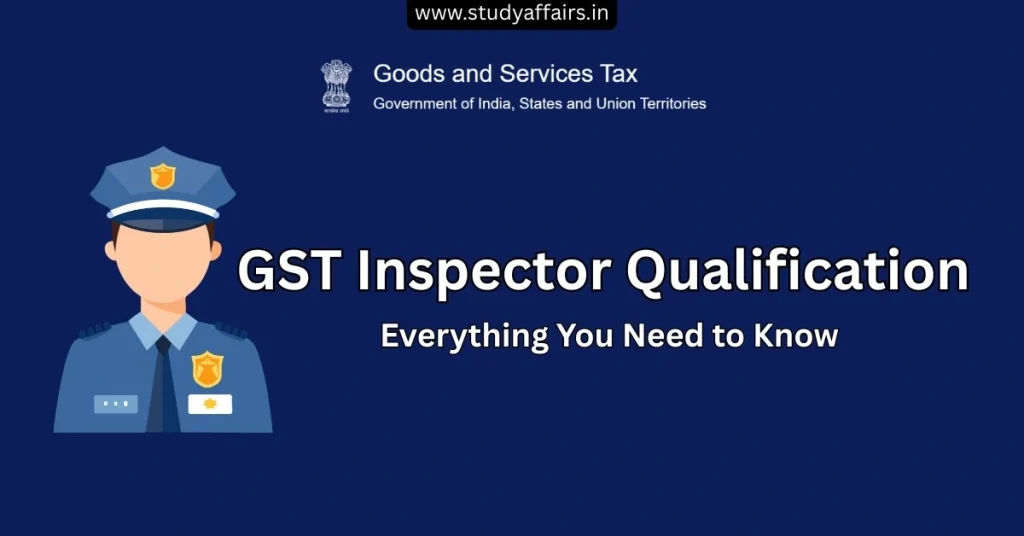
If you are searching for GST Inspector qualification, the first thing to understand is that the recruitment route is through the Staff Selection Commission (SSC) Combined Graduate Level (CGL) Examination. The post is officially listed by SSC as Inspector (Central Excise) under the Central Board of Indirect Taxes and Customs (CBIC). In everyday usage, this post is often referred to as a GST Inspector because CBIC officers work in the administration of central indirect taxes, including Central GST.
For the current SSC CGL 2026 recruitment, the basic educational requirement for the post is a Bachelor’s degree from a recognized university or equivalent. The post has an age limit of 18 to 30 years as on August 1, 2026, subject to applicable age relaxation. Unlike some SSC CGL posts, the Inspector (Central Excise) post also has specific physical standards and physical tests.
GST Inspector Qualification at a Glance
Here are the key eligibility requirements for the Inspector (Central Excise) post under CBIC in SSC CGL 2026:
| Requirement | Details |
| Recruitment exam | SSC CGL |
| Official post name | Inspector (Central Excise) |
| Department | CBIC |
| Pay Level | Level 7 |
| Educational qualification | Bachelor’s degree from a recognized university or equivalent |
| Age limit | 18–30 years |
| Age reference date | August 1, 2026 |
| Nationality | Indian citizen or other categories permitted under SSC rules |
| Physical requirements | Applicable |
| Physical test | Applicable |
| Selection | SSC CGL examination followed by post allocation and applicable standards |
SSC lists Inspector (Central Excise) as a Group B post under CBIC with a Pay Level-7 pay scale.
What Is the GST Inspector Qualification?
The primary GST Inspector qualification is graduation.
According to the SSC CGL 2026 notification, candidates applying for the Inspector (Central Excise) post must have a:
Bachelor’s Degree from a recognized University or equivalent.
SSC places Inspector (Central Excise) under its general category of “all other posts” for educational qualification purposes. The same bachelor’s-degree requirement therefore applies rather than requiring a specific subject such as commerce, economics or accounting.
This means a candidate can generally be eligible regardless of whether the graduation degree is in:
- Commerce
- Arts
- Science
- Engineering
- Business or management
- Humanities
- Another recognized bachelor’s degree discipline
The key condition is that the degree must be recognized and the candidate must satisfy the cut-off requirements in the SSC notification.
Is B.Com compulsory for a GST Inspector?
No. A B.Com degree is not compulsory for the Inspector (Central Excise) post.
SSC’s 2026 notification specifies a Bachelor’s degree from a recognized university or equivalent for all posts other than those for which a specific qualification is prescribed. Inspector (Central Excise) falls under the general bachelor’s-degree requirement.
So, a candidate with a BA, BSc, BCom, BBA, BTech or another recognized bachelor’s degree can potentially apply, provided all other eligibility conditions are met.
GST Inspector Age Limit
For SSC CGL 2026, the age limit for Inspector (Central Excise) is 18 to 30 years.
The crucial date for determining age is August 1, 2026. For posts carrying the 18–30-year age limit, SSC states that candidates must have been born:
- Not earlier than August 2, 1996
- Not later than August 1, 2008
Both dates are included in the prescribed range.
Age Relaxation
Eligible candidates can receive relaxation in the upper age limit under government rules. SSC’s 2026 notification specifies, among others:
| Category | Upper-age relaxation |
| SC/ST | 5 years |
| OBC | 3 years |
| PwBD | 10 years |
| PwBD + OBC | 13 years |
| PwBD + SC/ST | 15 years |
| Eligible Ex-Servicemen | 3 years after deduction of military service from actual age, subject to rules |
Other specific relaxation provisions also apply to certain categories of candidates. Candidates claiming age relaxation must produce the required supporting certificates when called for document verification.
Is There Any Percentage Requirement for GST Inspector?
For Inspector (Central Excise), the SSC CGL 2026 notification does not prescribe a minimum graduation percentage.
The stated requirement is a bachelor’s degree from a recognized university or an equivalent qualification. The special percentage or subject requirements listed in the notification apply to certain other posts, such as Junior Statistical Officer, rather than the Inspector (Central Excise) post.
So, if your graduation marks are below 60%, that by itself does not make you ineligible for the GST Inspector/Inspector (Central Excise) post, provided you meet the other requirements.
Can Final-Year Students Apply?
Final-year graduation students can apply for SSC CGL 2026, but there is an important condition.
SSC allows candidates who have appeared in their final year to apply, provided they possess the required educational qualification by August 1, 2026.
In other words, simply appearing for the final-year examination is not enough. The candidate must have acquired the required qualification by the prescribed cut-off date.
At document verification, candidates are required to produce relevant proof such as graduation mark sheets, a provisional certificate or degree certificate. SSC also states that the result of the qualifying examination must have been declared by the specified date.
Nationality Requirements
Educational qualifications alone are not enough. Candidates must also satisfy SSC’s nationality conditions.
Under the 2026 CGL notification, a candidate must generally be:
- A citizen of India;
- A subject of Nepal; or
- A subject of Bhutan;
The notification also covers certain persons of Indian origin who migrated from specified countries with the intention of permanently settling in India, subject to the prescribed conditions and Government of India eligibility certificate where required.
Physical Requirements for GST Inspector
This is one of the most important parts of GST Inspector eligibility that candidates sometimes overlook.
The Inspector (Central Excise) post has specific physical standards and physical tests. SSC includes Inspector (Central Excise), Inspector (Examiner) and Inspector (Preventive Officer) among the posts for which candidates must satisfy physical requirements.
For the Inspector (Central Excise) category, the 2026 notification specifies the following standards:
For Male Candidates
- Minimum height: 157.5 cm
- Chest: 81 cm fully expanded, with a minimum expansion of 5 cm
- Height relaxation of 5 cm is available for Garwalis, Assamese, Gorkhas and members of ST, subject to the applicable rules.
The physical tests include:
- Walking: 1,600 metres in 15 minutes
- Cycling: 8 km in 30 minutes
For Female Candidates
The prescribed minimum standards are:
- Height: 152 cm
- Weight: 48 kg
- Height relaxation of 2.5 cm and weight relaxation of 2 kg for eligible Gorkhas, Garwalis, Assamese and ST candidates.
The physical tests include:
- Walking: 1 km in 20 minutes
- Cycling: 3 km in 25 minutes
These standards are particularly relevant when selecting preferences in SSC CGL. A candidate should check the requirements before placing Inspector (Central Excise) high in the post-preference list.
Does GST Inspector Require a Physical Test?
Yes. The Inspector (Central Excise) post has prescribed physical standards and physical tests.
SSC explains that physical and medical requirements for relevant posts are assessed by the concerned user department after final selection and nomination. Candidates are therefore expected to check whether they meet the requirements before giving their post preferences.
This makes the post different from many other SSC CGL positions where educational and age eligibility are the main post-specific requirements.
SSC CGL Selection Process for GST Inspector
There is no separate examination called a “GST Inspector exam.” Candidates generally compete through the SSC CGL examination and indicate their preferences for available posts.
The broad route is:
- Meet the eligibility requirements
- Apply for SSC CGL
- Appear for the SSC CGL examinations
- Qualify according to the applicable selection criteria
- Submit post preferences when SSC asks for them
- Receive post allocation based on merit and preferences
- Undergo the required physical/medical standards where applicable
- Complete document verification and other formalities
SSC states that final allotment is based on merit-cum-preferences. It also warns that candidates selected for posts with specific physical, medical or educational requirements can have their candidature rejected if they fail to meet those requirements.
Documents Required to Prove GST Inspector Eligibility
Candidates should keep their educational and category documents in order well before document verification.
Relevant documents can include:
- Graduation mark sheets
- Degree or provisional certificate
- Matriculation/Secondary Examination certificate
- Valid category certificate, where applicable
- PwBD certificate, where applicable
- Ex-Servicemen documents, where applicable
- Equivalence certificate if claiming an equivalent qualification
SSC specifically states that candidates called for document verification must produce proof that they acquired the required educational qualification by the prescribed cut-off date. Failure to produce the necessary documents can result in cancellation of candidature.
Is a GST or Taxation Course Required?
No separate GST certification is prescribed as the educational qualification for Inspector (Central Excise) through SSC CGL.
A candidate does not need to complete a GST course, CA qualification, CS qualification or taxation diploma simply to satisfy the basic educational eligibility for this post. SSC’s stated requirement is a bachelor’s degree from a recognized university or equivalent.
Knowledge of taxation and GST can certainly be useful for understanding the work, but it is different from the formal eligibility requirement for recruitment.
GST Inspector vs Other SSC CGL Inspector Posts
SSC CGL includes several inspector-level positions, and their requirements are not always identical.
For example, the 2026 notification lists:
- Inspector of Income Tax — CBDT
- Inspector (Central Excise) — CBIC
- Inspector (Preventive Officer) — CBIC
- Inspector (Examiner) — CBIC
- Inspector — Central Bureau of Narcotics
- Inspector Posts — Department of Posts
The Inspector (Central Excise) post has an 18–30 years age limit and specific physical requirements. Candidates should therefore avoid assuming that eligibility for one inspector post automatically means eligibility for every other inspector post.
What Does a GST Inspector Do?
The term “GST Inspector” is commonly used by aspirants, but the official SSC post name is Inspector (Central Excise) under CBIC.
CBIC is responsible for administration of Central GST and related central indirect-tax functions. The Central Goods and Services Tax Act also provides for officers of Central Tax, including various classes of officers appointed for purposes of the Act.
The exact duties of an individual inspector can depend on the assignment and department requirements. They can involve tax administration, verification, compliance-related work, examination of records and other field or office responsibilities associated with the department.
Important Points Before Choosing the Post
If you are targeting the GST Inspector post through SSC CGL, don’t stop after checking your graduation degree.
Before selecting the post, verify all of the following:
- You have a recognized bachelor’s degree.
- You satisfy the age requirement on the prescribed date.
- Your date of birth matches your matriculation/secondary certificate.
- You have the required category documents if claiming relaxation.
- You meet the physical standards.
- You can complete the prescribed physical tests.
- You understand that post allocation depends on merit and preferences.
- You are prepared for document verification and departmental requirements.
SSC specifically states that the date of birth recorded in the Matriculation/Secondary Examination Certificate is used for determining age, and subsequent requests to change it are not accepted.
Frequently Asked Questions
The minimum educational qualification for the SSC CGL Inspector (Central Excise) post is a Bachelor’s degree from a recognized university or equivalent.
No. SSC does not require B.Com specifically. Graduates from recognized bachelor’s-degree programmes in different disciplines can apply if they meet the remaining eligibility conditions.
For Inspector (Central Excise), the age limit is 18 to 30 years as on August 1, 2026. The prescribed date-of-birth range is August 2, 1996 to August 1, 2008, before applying any eligible age relaxation.
Yes. Inspector (Central Excise) has specified physical standards and physical tests. For example, the prescribed male standards include 157.5 cm height and an 81 cm chest with minimum 5 cm expansion, along with walking and cycling tests. Female candidates have separate height, weight and physical-test requirements.
A final-year student can apply for SSC CGL, but the required bachelor’s degree must be acquired by August 1, 2026 for the 2026 examination. The result must also have been declared by the prescribed date.
No. SSC’s educational qualification does not require a separate GST certificate or taxation course. The basic requirement is a recognized bachelor’s degree or equivalent.
Conclusion
The GST Inspector qualification is straightforward at the educational level: candidates need a recognized bachelor’s degree or equivalent and must satisfy the SSC CGL age and nationality requirements. For SSC CGL 2026, the Inspector (Central Excise) post under CBIC has an 18–30 years age limit as on August 1, 2026.
The part that deserves extra attention is the physical eligibility. Inspector (Central Excise) is among the SSC CGL posts with prescribed physical standards and tests, so candidates should check those requirements before choosing the post in their preferences.
For the latest notification, application updates and any corrigenda, candidates should rely on the official Staff Selection Commission website and the applicable SSC CGL notice rather than older recruitment articles.
Click here to read this article in Hindi.