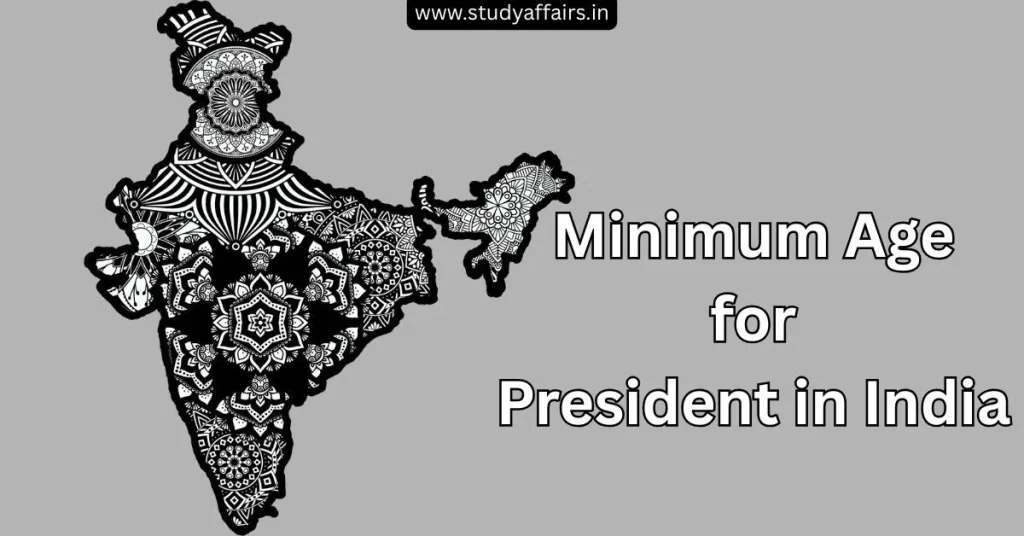
The minimum age for president in India is a topic that often sparks curiosity among students, aspiring politicians, and general readers interested in the Indian Constitution. The office of the President of India represents the pinnacle of democratic leadership in the country. It is the highest constitutional authority – the head of the Indian Republic – and symbolizes the unity, integrity, and dignity of the nation.
But not everyone can become the President. The Indian Constitution lays down specific qualifications and conditions that must be fulfilled. Among these, the minimum age for president in India plays a crucial role. Understanding this requirement – along with other eligibility conditions, election procedures, and responsibilities – provides a comprehensive view of the Indian political framework.
In this detailed article, we’ll explore everything you need to know about the minimum age for president in India, along with related details about qualifications, nomination process, election procedures, powers, and historical insights.
Constitutional Basis: Where is the Minimum Age for President in India Mentioned?
The minimum age for president in India is explicitly mentioned in the Indian Constitution. According to Article 58(1)(b) of the Constitution of India:
“No person shall be eligible for election as President unless he has completed the age of thirty-five years.”
Therefore, the minimum age for president in India is 35 years.
This means any Indian citizen who is at least 35 years old can contest the presidential election – provided they meet other constitutional requirements. This age criterion ensures that the person occupying the office has adequate maturity, experience, and understanding of political, social, and administrative matters.
Why is the Minimum Age for President in India 35 Years?
The framers of the Indian Constitution intentionally set 35 years as the minimum age for president of India to ensure that the individual holding the highest constitutional office possesses sufficient wisdom and maturity.
Here are a few reasons for this age criterion:
- Political Maturity: At 35, a person is likely to have gained enough life experience and understanding of the country’s governance.
- Administrative Insight: The role of President demands sound judgment and awareness of constitutional procedures.
- Consistency with Other Offices: The minimum age for a Rajya Sabha member is 30 years, and for a Lok Sabha member, it is 25 years. As the President is above both Houses, a higher age threshold of 35 is logical.
- Historical Precedents: Many democratic nations, including the United States, have similar provisions. For example, the minimum age to become President of the U.S. is also 35.
Thus, the minimum age for president in India was set thoughtfully, balancing youthfulness with maturity.
Eligibility Criteria: Beyond the Minimum Age Requirement
Apart from the minimum age for president in India, Article 58 of the Constitution outlines other qualifications:
(a) Citizenship
The person must be a citizen of India.
(b) Age
The person must have completed the age of 35 years (the minimum age for president in India).
(c) Qualification for Election to Lok Sabha
The person must be qualified to be elected as a member of the Lok Sabha.
(d) No Office of Profit
The candidate must not hold any office of profit under the Government of India, the Government of any State, or any local or other authority subject to their control.
Exceptions include:
- President or Vice-President of India,
- Governor of any State, and
- Minister of the Union or any State.
In short, the min age for president of India is only one part of the eligibility framework. The overall criteria ensure that only capable and constitutionally sound individuals can contest.
Nomination Process for Presidential Election
Understanding how one becomes a candidate for President is equally important.
To be nominated:
- The candidate’s name must be proposed by at least 50 electors and seconded by another 50 electors (these electors can be MPs or MLAs who are part of the Electoral College).
- The candidate must also deposit ₹15,000 as a security deposit with the Reserve Bank of India.
Only those meeting the minimum age for president in India and other qualifications can file nominations.
Electoral College: Who Votes for the President of India?
The President of India is not directly elected by the general public. Instead, an Electoral College is responsible for electing the President.
It comprises:
- Elected Members of both Houses of Parliament (Lok Sabha and Rajya Sabha)
- Elected Members of the Legislative Assemblies of States (including Delhi and Puducherry)
This indirect election system ensures a balance between the federal and democratic structures of India.
Election Procedure: How is the President Elected?
The election follows the system of proportional representation by means of the single transferable vote (STV). Voting is done through a secret ballot.
Here’s how it works:
- Each elector has a fixed number of votes.
- The value of each MLA’s vote depends on the population of their state.
- The value of each MP’s vote ensures parity between the votes of Parliament and State Assemblies.
- A candidate must secure more than 50% of the total valid votes to win.
Thus, while the minimum age for president in India is a key eligibility factor, the electoral process ensures the most widely acceptable candidate is chosen.
Term of Office and Oath
Once elected, the President serves for a term of five years from the date of entering office.
Before assuming office, the President takes an oath or affirmation before the Chief Justice of India (or the senior-most judge available), pledging to:
- faithfully execute the office of the President of India, and
- preserve, protect, and defend the Constitution and the law.
Powers and Functions of the President
The President of India is the constitutional head of the nation. Though the office is largely ceremonial, the President’s powers are wide-ranging.
1. Executive Powers
- Appoints the Prime Minister and other ministers.
- Appoints governors, judges of the Supreme Court and High Courts, ambassadors, etc.
2. Legislative Powers
- Summons, prorogues, and dissolves Parliament.
- Gives assent to bills or returns them (except money bills) for reconsideration.
- Can issue Ordinances when Parliament is not in session.
3. Financial Powers
- All money bills require the President’s recommendation.
- Oversees the Union Budget presentation.
4. Judicial Powers
- Has the power to grant pardons, reprieves, respites, or remissions of punishment.
5. Emergency Powers
- Can declare National, State, or Financial Emergencies under Articles 352, 356, and 360.
Holding such vast powers necessitates high constitutional integrity – one reason the minimum age for president in India is set at 35 years.
Minimum Age for Other Constitutional Posts
| Position | Minimum Age Requirement |
| President of India | 35 years |
| Vice President of India | 35 years |
| Governor of a State | 35 years |
| Member of Lok Sabha | 25 years |
| Member of Rajya Sabha | 30 years |
| Member of Legislative Assembly | 25 years |
| Member of Legislative Council | 30 years |
As the table shows, 35 years is the highest minimum age among the major constitutional posts – highlighting the stature and responsibility of the President’s office.
Historical Insights: Youngest and Oldest Presidents of India
Although the minimum age for president in India is 35 years, no one close to that age has ever been elected.
Youngest President:
Dr. Neelam Sanjiva Reddy was the youngest person to hold the office, aged 64 years when elected in 1977.
Oldest President:
Dr. Rajendra Prasad, the first President of India, was 65 years old when he assumed office in 1950, but later Dr. Shankar Dayal Sharma (71 years) and Pratibha Patil (72 years) were even older.
This shows that, in practice, Presidents have typically been senior leaders with decades of experience in public life.
International Comparison: Minimum Age for President Across Countries
| Country | Minimum Age Requirement |
| India | 35 years |
| United States | 35 years |
| France | 18 years |
| Brazil | 35 years |
| Germany | 40 years |
| South Korea | 40 years |
| Russia | 35 years |
India’s requirement aligns closely with other democratic nations, ensuring the President’s maturity and experience are beyond doubt.
Can a 34-Year-Old Become President of India?
No. A person must have completed 35 years of age before filing a nomination. Even if a person turns 35 during the election process, they are not eligible unless they meet the age criterion on the nomination date.
This strict rule ensures constitutional clarity and uniformity.
Disqualification of the President
Even after fulfilling the minimum age for president in India, a person may be disqualified if:
- They are not a citizen of India.
- They hold an office of profit.
- They are declared of unsound mind by a competent court.
- They are an undischarged insolvent.
Thus, the President must not only meet the min age for president of India but also uphold constitutional probity.
Removal or Impeachment of the President
The President can be removed from office only through impeachment for violation of the Constitution.
This process is detailed in Article 61 and involves:
- A resolution in either House of Parliament.
- A two-thirds majority vote.
- An investigation and opportunity for defense.
This rigorous process reflects the dignity and protection attached to the post – another reason why the minimum age for president in India is relatively high.
Frequently Asked Questions (FAQs)
The minimum age for president in India is 35 years, as per Article 58(1)(b) of the Constitution.
Both the President and Vice President must be at least 35 years old, while a Prime Minister must be at least 25 years old (if from Lok Sabha).
No, because the minimum age for president in India is 35 years.
The person must be an Indian citizen, at least 35 years old, qualified for Lok Sabha, and not hold any office of profit.
It ensures maturity, experience, and a balanced temperament – essential for the head of state.
Understanding the Significance of the Minimum Age for President in India
The minimum age for president in India – 35 years – is not an arbitrary number. It represents the balance between youthful energy and experienced wisdom. The framers of the Constitution ensured that the person holding the highest office in the country has sufficient life experience, political maturity, and understanding of India’s democratic framework.
While theoretically any Indian citizen over 35 can become President, in practice, the office is reserved for individuals with exceptional political careers, public service, or intellectual stature.In essence, the minimum age for president in India reflects the nation’s commitment to responsible and mature leadership at the helm of its constitutional framework.
Click here to read this article in Hindi.