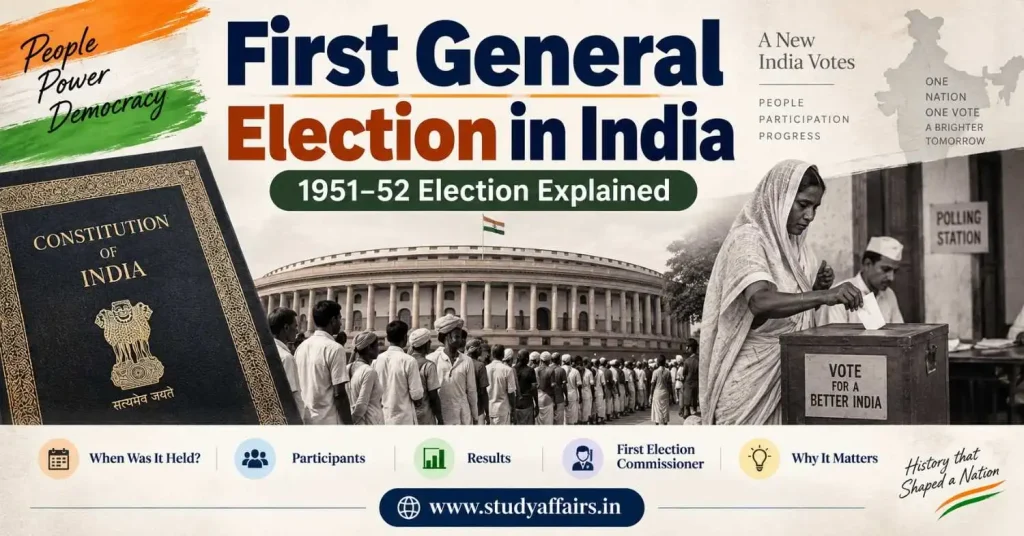
The first general election in India was a landmark event in the country’s democratic history. Held soon after independence, it gave Indian citizens the opportunity to elect their representatives through universal adult franchise. The election was conducted across a vast and diverse country where millions of people were voting in a democratic exercise on an unprecedented scale.
The election was held from October 1951 to February 1952 and resulted in the formation of the first Lok Sabha. The Indian National Congress emerged as the largest political party, with Jawaharlal Nehru becoming the first Prime Minister of the elected government.
When Was the First General Election Held in India?
The first general election held in India took place between 1951 and 1952. Voting began in October 1951, while polling in many constituencies continued into early 1952.
If the question is when was the first election held in India after independence, the answer depends on what is meant by “election.” India had elections to legislative bodies before independence, but the first nationwide general election conducted under the Constitution of independent India was the 1951–52 general election.
The first general election of India after independence was based on the principle of universal adult suffrage. This meant that ordinary adult citizens were given the right to participate in choosing their representatives, regardless of their social or economic background.
At the time, organizing such an election was an enormous administrative challenge. India had a large population, considerable illiteracy, limited transportation infrastructure and many remote areas. Election authorities therefore had to develop practical methods to ensure that citizens could cast their votes.
When Was India’s First Lok Sabha Election Held?
The first Lok Sabha election in India was conducted as part of the 1951–52 general election. The Lok Sabha is the lower house of India’s Parliament, and its first elected members formed the country’s first Lok Sabha.
So, if someone asks when was the first Lok Sabha election held, the commonly accepted answer is 1951–52.
The first Lok Sabha election date cannot be represented by one single polling date because voting did not take place throughout India on the same day. Polling was conducted in different areas over several months.
The 1st Lok Sabha election was particularly significant because it transformed the constitutional promise of representative democracy into a nationwide electoral process. Voters were choosing members of Parliament who would represent their constituencies in the newly established democratic system.
1951–52 General Election
The 1951 general election and 1952 general election are often mentioned separately in historical discussions, but they refer to the same first nationwide electoral process. It began in 1951 and concluded in 1952, which is why it is generally called the 1951–52 Indian general election.
The election was conducted for the Lok Sabha as well as for state legislative assemblies. The Election Commission of India had to organize polling across thousands of constituencies and establish an electoral system that could work in conditions very different from those of modern elections.
One of the notable features of the 1951 election was the use of ballot boxes and symbols to help voters identify candidates and parties. Symbols were especially important because a substantial part of the population was unable to read or write.
By the time the 1952 election process was completed, India had demonstrated that a large and newly independent country could conduct a nationwide democratic election.
First General Election Results
The first Lok Sabha election results established the political foundation of the Republic of India. The Indian National Congress won a clear majority of the seats and became the dominant party in the first Lok Sabha.
Congress won 364 of the 489 Lok Sabha seats contested in the election. Its performance was considerably ahead of the other political parties and independents.
Jawaharlal Nehru led the Congress campaign and subsequently became the first Prime Minister of India to lead a government formed following a nationwide general election.
The 1st Lok Sabha election results also demonstrated that Indian voters did not simply participate in the democratic process; they actively determined the composition of the country’s first elected Parliament.
The 1952 election results in India therefore have historical importance beyond the numbers. They marked the beginning of India’s continuing system of parliamentary elections.
Participants in the First General Election
The first general election in India participants included political parties, independent candidates and millions of ordinary voters. Hundreds of political parties and independent candidates took part in the electoral process.
The scale of voter participation was remarkable for a newly independent country. Approximately 173 million people were eligible to vote, with around 45% of eligible voters participating.
The election also required the creation of an extensive electoral infrastructure. Polling stations had to be established in urban areas, villages and remote regions so that eligible citizens could exercise their right to vote.
Who Was India’s First Voter?
The story of India’s first voter is associated with Shyam Saran Negi, a schoolteacher from Himachal Pradesh. He cast his vote ahead of the main polling schedule in October 1951 because the region where he lived was expected to experience severe winter conditions.
Negi later became widely recognized as one of the symbolic figures associated with India’s first general election and the country’s electoral journey.
It is worth distinguishing this from the idea of the literal “first vote in India.” India had elections before independence, so the phrase can be misleading if used without historical context. In discussions about independent India’s first general election, however, Shyam Saran Negi is popularly remembered for casting an early vote in the 1951–52 election.
First Election Commissioner of India
The person who played a central role in organizing India’s first general election was Sukumar Sen, the country’s first Chief Election Commissioner.
If you are asking who was the first Chief Election Commissioner of India, the answer is Sukumar Sen.
He became the first Election Commissioner in India when the Election Commission was established in 1950. Sen was responsible for helping develop the administrative framework needed for India’s first nationwide election.
The task was particularly difficult because the country had to create electoral rolls, determine constituencies, arrange polling stations, train election personnel and develop procedures for voting in a population with widely varying levels of literacy.
Sukumar Sen served as Chief Election Commissioner from 1950 to 1958 and also oversaw the second general election held in 1957.
Importance of India’s First General Election
The importance of the first general election in India goes far beyond the formation of the first Lok Sabha. It established a democratic tradition that has continued through subsequent elections.
1. Beginning of Electoral Democracy
The election converted the principles of India’s Constitution into an actual nationwide democratic process. Citizens were able to choose their representatives through elections rather than having political authority determined solely by appointment or inheritance.
2. Universal Adult Franchise
One of the most remarkable aspects of India’s electoral system was the decision to provide voting rights broadly to adult citizens from the beginning of the Republic. India did not introduce democracy gradually by first restricting voting rights to wealthy or highly educated groups.
3. Formation of the First Lok Sabha
The election resulted in India’s first elected Lok Sabha. This provided the parliamentary foundation for the functioning of the new republic.
4. Development of the Election Commission
The election also established the importance of an independent electoral administration. The Election Commission’s role in conducting elections became a fundamental part of India’s democratic system.
5. Foundation for Future Elections
The history of general elections in India can be traced through the elections that followed the 1951–52 election. India subsequently held general elections at regular constitutional intervals, with voters repeatedly determining the composition of the Lok Sabha.
The general elections in India since independence have seen major changes in political parties, voter participation, technology, campaigning and electoral administration. However, the basic democratic principle established by the first election remains central to the system.
Conclusion
The first general election in India, conducted during 1951–52, was one of the most significant events in the country’s early democratic history. It resulted in the formation of the first Lok Sabha and demonstrated that a newly independent, highly diverse nation could conduct a nationwide election based on universal adult suffrage.
From the organizational efforts of Sukumar Sen to the participation of millions of voters, the election created the foundation for India’s parliamentary democracy. The first Parliament election in India was therefore not merely a political contest; it was the beginning of a continuing electoral tradition that has shaped the country’s democratic development.
FAQs
1. When was the first general election held in India?
The first general election in India was held from 1951 to 1952. Polling began in October 1951 and continued across different parts of the country until early 1952.
2. When was the first Lok Sabha election held in India?
The first Lok Sabha election in India was held during the 1951–52 general election. It led to the formation of the First Lok Sabha.
3. Who won the first general election in India?
The Indian National Congress won the first general election, securing 364 of the 489 Lok Sabha seats contested.
4. Who was the first Chief Election Commissioner of India?
Sukumar Sen was the first Chief Election Commissioner of India. He played a key role in organizing and conducting the first general election in 1951–52.
5. Who was India’s first voter?
Shyam Saran Negi, a schoolteacher from Himachal Pradesh, is widely recognized as India’s first voter. He cast his vote in October 1951, ahead of the main polling schedule.