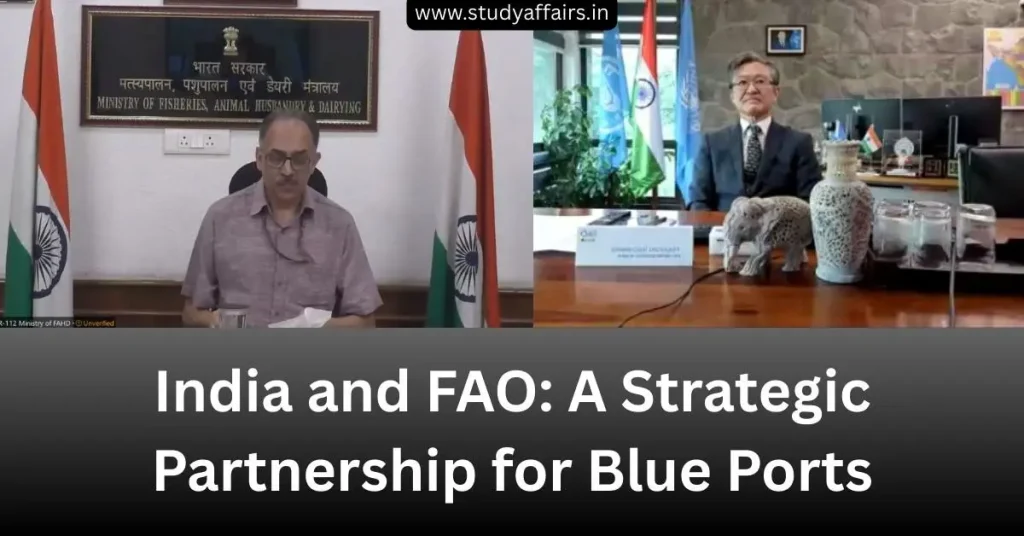
In a historic collaboration, the Department of Fisheries (DoF), Ministry of Fisheries, Animal Husbandry and Dairying (MoFAHD) has signed a Technical Cooperation Programme (TCP) agreement with the Food and Agriculture Organization (FAO) of the United Nations. This partnership aims to strengthen Blue Port infrastructure in India, focusing on sustainability, smart technology integration, and global best practices.
As part of this initiative, the DoF organized the first capacity-building webinar in a series of three, with participation from international experts, government officials, and fisheries stakeholders.
The webinar titled “Foundations of a Blue Port: Generating Value in Fishing Ports” was addressed by Dr. Abhilaksh Likhi, Secretary, Department of Fisheries, and saw participation from Mr. Takayuki Hagiwara, FAO Representative in India.
Smart Fishing Ports: The Future of Indian Fisheries
During his keynote address, Dr. Likhi emphasized that fishing ports are more than just physical infrastructure—they are strategic gateways to economic prosperity, ecological sustainability, and social inclusion. He outlined the government’s vision to build ecologically healthy, socially inclusive, and economically viable fisheries systems that will contribute to India’s food and nutritional security.
He highlighted the integration of cutting-edge technologies such as:
- Artificial Intelligence (AI) for predictive analytics in fisheries
- 5G connectivity for real-time communication and monitoring
- Automation & digital platforms to improve efficiency and service delivery
- IoT and satellite-based systems for smarter operations
Dr. Likhi also acknowledged the role of flagship schemes like Pradhan Mantri Matsya Sampada Yojana (PMMSY) and FIDF (Fisheries and Aquaculture Infrastructure Development Fund) in modernizing the sector and empowering stakeholders.
Major Investments in Blue Port Development
Under the PMMSY scheme, India is developing three Smart and Integrated Fishing Harbours in:
- Vanakbara (Diu)
- Jakhau (Gujarat)
- Karaikal (Puducherry)
These projects represent a total investment of ₹369.80 crores. The upgraded harbours will feature:
- Eco-friendly infrastructure with rainwater harvesting, solar and energy-efficient lighting, and electric-powered equipment
- Waste management systems, including sewage treatment plants and marine debris clean-up mechanisms
- Advanced post-harvest facilities to ensure cleaner, safer, and more efficient operations
These world-class fishing harbours are expected to boost exports, generate livelihoods, improve traceability, and reduce the environmental footprint of port operations.
FAO’s Global Expertise and Knowledge Sharing
The webinar included expert sessions by FAO officials Mr. Jose Estors, Ms. Yolanda Molares, and Ms. Lucia Lopez de Aragon, who shared insights on:
- The Blue Ports concept as a tool for sustainability and innovation
- A case study on the Port of Vigo (Spain), showcasing best practices in eco-friendly and community-driven port management
- Strategies for stakeholder collaboration and climate resilience in fisheries infrastructure
These deliberations are expected to help India align its fisheries infrastructure with global standards, making fishing ports technologically advanced, environmentally sustainable, and socially inclusive.
Blue Ports Framework: A Vision for the Future
The Blue Ports framework blends technology, ecology, and economy to create integrated fishing harbours that serve both people and the planet. By combining IoT devices, sensor networks, automation, and data-driven solutions with eco-conscious features, India’s Blue Ports are set to transform the fishing sector.This initiative will not only strengthen food security but also empower coastal communities, enhance export competitiveness, and create a climate-resilient fisheries ecosystem.
A: India and the FAO have partnered to develop world-class Blue Ports, with smart and integrated fishing harbours worth ₹369.8 crores being built in Gujarat, Daman & Diu, and Puducherry to boost sustainability and fisheries infrastructure.
Conclusion
The India–FAO collaboration on Blue Ports marks a significant step towards building a sustainable, inclusive, and technology-driven fisheries sector. With investments worth ₹369.8 crores and strong global cooperation, India is set to establish itself as a leader in modern fishing port development.As the Blue Ports initiative unfolds, it promises to ensure better livelihoods, healthier ecosystems, and a stronger economy—paving the way for a blue revolution in India’s maritime sector.
Click here to read this article in Hindi.


