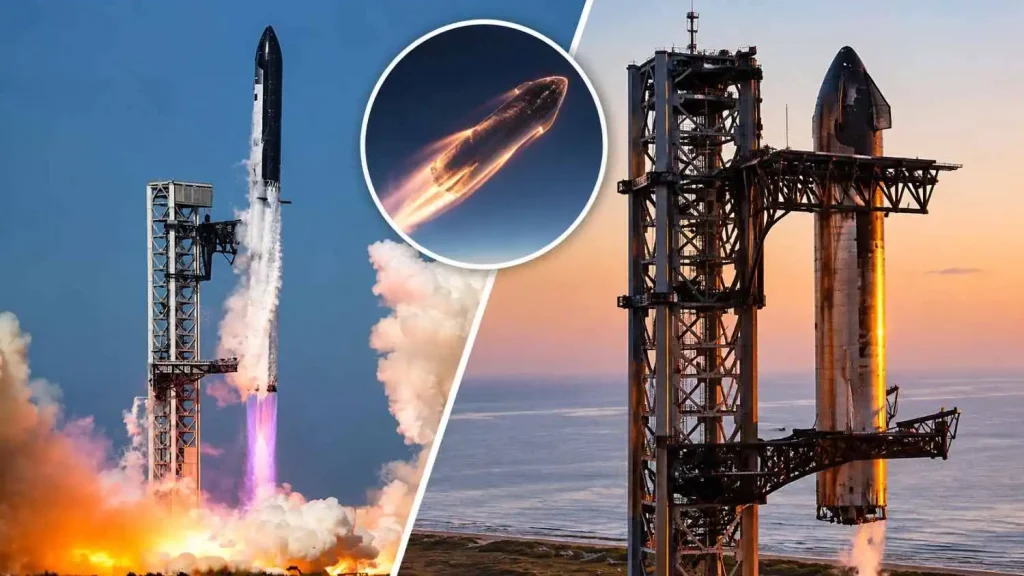
The latest SpaceX Starship launch has marked an important milestone in the development of reusable rockets. SpaceX launched its Starship Flight 15 mission on November 13, 2026, from Starbase in South Texas, United States. The mission aimed to demonstrate the recovery of both the Super Heavy booster and the Starship spacecraft using the mechanical arms of the launch tower.
The mission achieved a historic result on November 14, when SpaceX successfully caught the returning Starship spacecraft using the tower’s giant mechanical arms, popularly known as chopsticks. However, the Super Heavy booster did not complete its planned recovery and was diverted towards the Gulf of Mexico.
Despite the unsuccessful booster recovery, Flight 15 demonstrated that SpaceX could bring an orbital Starship spacecraft back to its launch site and catch it using a specially designed recovery system.
The achievement is significant for the future of reusable rockets, commercial spaceflight and NASA’s lunar exploration plans.
In this article, we explain the SpaceX Starship Flight 15 launch, its important milestones, the successful spacecraft catch, the booster recovery problem and what this development means for future space missions.
SpaceX Starship Launch 2026: Latest Update
SpaceX successfully launched Starship Flight 15 on November 13, 2026, from its Starbase facility in Texas.
The mission’s main objective was to test the performance of the two-stage Starship launch system and attempt to recover both stages at the launch site.
The Starship spacecraft successfully reached low Earth orbit, deployed 26 Starlink V3 satellites and completed approximately 14 orbits around Earth before returning.
The most significant achievement occurred on November 14, when the spacecraft returned to Starbase and was successfully caught by the launch tower’s mechanical arms.
However, the Super Heavy booster could not be recovered at the launch tower because its planned catch attempt was aborted. The booster was diverted to an offshore splashdown in the Gulf of Mexico.
Important Flight 15 Details
| Particular | Details |
|---|---|
| Mission | Starship Flight 15 |
| Company | SpaceX |
| Launch date | November 13, 2026 |
| Spacecraft recovery date | November 14, 2026 |
| Launch location | Starbase, Texas, USA |
| Rocket system | Starship and Super Heavy |
| Booster | Booster 22 |
| Spacecraft | Ship 42 |
| Satellites deployed | 26 Starlink V3 satellites |
| Approximate Earth orbits | 14 |
| Spacecraft recovery | Successful |
| Booster recovery | Aborted |
| Spacecraft recovery method | Launch tower mechanical-arm catch |
Source: SpaceX and Space.com mission coverage.
When Was the SpaceX Starship Flight 15 Launch?
SpaceX launched Starship Flight 15 on Friday, November 13, 2026, from Starbase, Texas.
The launch took place at approximately 4:47 p.m. Central Standard Time (CST), according to mission coverage.
For readers in India, this corresponds to approximately 4:17 a.m. IST on November 14.
The spacecraft returned to Starbase on November 14 at approximately 4:21 p.m. Eastern Standard Time (EST), corresponding to approximately 2:51 a.m. IST on November 15.
The mission lasted approximately 22.5 hours from launch to spacecraft recovery.
Launch and Recovery Timings
| Event | US Local Time | Indian Standard Time |
|---|---|---|
| Starship launch | Nov 13, approximately 4:47 p.m. CST | Nov 14, approximately 4:17 a.m. IST |
| Spacecraft recovery | Nov 14, approximately 4:21 p.m. EST | Nov 15, approximately 2:51 a.m. IST |
These are reported event times, not future launch schedules.
What Is SpaceX Starship?
Starship is a reusable rocket and spacecraft transportation system developed by SpaceX, the American aerospace company founded by Elon Musk.
It is designed to transport cargo and people to Earth orbit, the Moon and eventually Mars.
Unlike conventional launch vehicles that discard major rocket stages during flight, Starship is being developed with the objective of recovering and reusing both its main stages.
The complete Starship launch system consists of two major components.
1. Super Heavy Booster
Super Heavy is the first stage of the Starship launch system.
Its main responsibility is to provide the thrust required to lift the enormous rocket away from Earth.
Important features include:
- It is approximately 72 metres tall.
- It uses 33 Raptor engines.
- It runs on liquid methane and liquid oxygen.
- It is designed to return to the launch site for recovery and reuse.
After separating from the spacecraft, the booster performs manoeuvres to return towards the launch tower.
2. Starship Spacecraft
Starship is the upper stage of the launch system and the vehicle designed to carry cargo and crew.
Its important features include:
- It is approximately 52 metres tall.
- It uses six Raptor engines.
- It is designed to operate in space.
- It has a heat shield for atmospheric reentry.
- It is being developed for missions to Earth orbit, the Moon and Mars.
The complete Starship and Super Heavy system stands approximately 124 metres tall, making it one of the largest launch vehicles ever developed.
What Happened During the SpaceX Starship Flight 15 Mission?
Flight 15 was designed to demonstrate several important technologies, including launch performance, stage separation, satellite deployment, atmospheric reentry and recovery of the spacecraft.
Here is a chronological explanation of the mission.
1. Successful Launch from Texas
On November 13, 2026, SpaceX launched its Starship rocket from Starbase, Texas.
The Super Heavy booster provided the thrust required to lift the enormous rocket into the atmosphere.
The rocket successfully passed through the early stages of flight and reached the planned stage-separation sequence.
2. Successful Stage Separation
After the initial powered ascent, the Super Heavy booster separated from the Starship upper stage.
This process allows the spacecraft to continue its journey while the booster begins its return manoeuvres.
The Starship spacecraft continued its ascent using its own Raptor engines.
3. Super Heavy Booster Recovery Attempt Aborted
One of the major objectives of Flight 15 was to catch the Super Heavy booster using the mechanical arms of the launch tower.
However, the booster did not complete its planned return.
SpaceX aborted the planned tower catch and diverted Booster 22 towards an offshore splashdown in the Gulf of Mexico.
The exact technical reason for the recovery abort was not established in the initial mission coverage. SpaceX indicated that it would investigate the cause.
It is therefore important not to present any unconfirmed technical explanation as the official reason for the failure.
4. Starship Successfully Reached Orbit
Although the booster recovery attempt was unsuccessful, the upper-stage spacecraft continued its mission.
Ship 42 successfully reached low Earth orbit and completed its planned orbital operations.
This allowed SpaceX to continue testing the spacecraft independently of the booster recovery problem.
5. Deployment of 26 Starlink V3 Satellites
One of the important objectives of Flight 15 was the deployment of 26 Starlink V3 satellites.
The spacecraft released these satellites into orbit during its mission.
The satellites are part of SpaceX’s next-generation Starlink network, which is intended to increase the capacity and performance of its satellite internet service.
The deployment also provided an opportunity to test Starship’s ability to transport and release payloads in space.
Three of the satellites carried cameras intended to provide additional observations of the spacecraft’s heat shield.
6. Starship Completed Approximately 14 Earth Orbits
After deploying its payload, Starship continued its extended orbital mission.
It completed approximately 14 orbits around Earth at an altitude of roughly 275 kilometres.
This was an important part of the test because the spacecraft needed to remain in orbit for an extended period before attempting its return to Earth.
The mission also provided additional information about spacecraft performance and heat-shield conditions.
7. Successful Atmospheric Reentry
Returning from orbit is one of the most challenging parts of a spacecraft mission.
As Starship reentered Earth’s atmosphere, it experienced extremely high temperatures caused by atmospheric compression and aerodynamic heating.
Its heat shield was designed to protect the vehicle from these conditions.
SpaceX monitored the spacecraft’s condition and evaluated available heat-shield information before the final return.
The spacecraft subsequently proceeded with its planned return-to-launch-site manoeuvre.
8. Historic Starship Catch at Starbase
The most important moment of Flight 15 occurred on November 14, 2026.
After completing its orbital mission and atmospheric reentry, Starship returned towards its launch site in South Texas.
The spacecraft performed its final landing manoeuvres and approached the launch tower.
The tower’s two giant mechanical arms, popularly known as chopsticks, positioned themselves to catch the returning vehicle.
SpaceX successfully caught the Starship spacecraft at approximately 4:21 p.m. EST.
This marked the first successful recovery of a Starship upper-stage spacecraft using the launch tower’s mechanical-arm system.
It was a major achievement because catching a spacecraft returning from orbit presents different technical challenges from recovering a booster shortly after its separation.
How Does the SpaceX Chopsticks Catch System Work?
One of the most interesting features of the Starship launch system is its tower-based recovery mechanism.
SpaceX has developed a large launch tower equipped with two mechanical arms that can catch returning rocket stages.
These arms are commonly called chopsticks because of their appearance and movement.
Suggested image: SpaceX Starship spacecraft being caught by the Mechazilla launch tower’s mechanical arms.
The recovery system is designed to eliminate the need for conventional landing legs.
How the Recovery Process Works
The process involves several important stages.
Step 1: Controlled return
The returning vehicle uses its engines and flight-control systems to approach the launch tower.
Step 2: Position adjustment
The vehicle makes the necessary manoeuvres to reach the correct position and orientation for recovery.
Step 3: Final landing manoeuvre
The spacecraft performs a controlled descent and uses its engines to manage its final approach.
Step 4: Mechanical-arm catch
The tower’s mechanical arms position themselves to catch and support the vehicle.
Step 5: Inspection and preparation
After recovery, engineers can inspect the vehicle and evaluate its condition before determining whether it is suitable for further testing or reuse.
Why Is This System Important?
Traditional rockets often discard their first stages after launch. Recoverable boosters can reduce the amount of hardware that must be manufactured for every mission.
SpaceX wants to extend this approach to the entire Starship launch system.
A successful tower catch could help make future recovery operations more efficient by reducing the need for separate landing platforms, recovery ships and additional landing equipment.
However, catching a vehicle does not automatically mean it is ready to fly again. Inspection, maintenance, testing and operational approval are still necessary.
Why Was the SpaceX Starship Flight 15 Mission Important?
Flight 15 was significant for several reasons.
1. First Successful Catch of the Starship Spacecraft
The biggest achievement was the successful recovery of the Starship upper stage at the launch tower.
SpaceX had previously demonstrated tower catches of Super Heavy boosters, but catching Starship after an orbital flight was a different challenge.
The spacecraft had to survive atmospheric reentry and perform a precise return manoeuvre before reaching the tower.
Flight 15 demonstrated that this recovery method could work for the spacecraft itself.
2. Progress Towards Fully Reusable Rockets
Rocket reusability is one of the central objectives of the Starship programme.
If both stages can be recovered, inspected, refurbished and reused efficiently, SpaceX could potentially reduce launch costs and increase launch frequency.
The successful Ship catch is an important step towards that objective.
However, Flight 15 did not demonstrate complete recovery of both stages because the booster recovery attempt was aborted.
3. Improved Heat-Shield Testing
The spacecraft’s heat shield is essential for surviving atmospheric reentry.
During the mission, SpaceX used observations from cameras on three deployed satellites to gather additional heat-shield information.
This information can help engineers identify weaknesses and improve the design of future spacecraft.
4. Support for Future Lunar Exploration
Starship is also important for NASA’s Artemis programme.
NASA is working with SpaceX to develop a specialised Starship Human Landing System (HLS) for transporting astronauts between lunar orbit and the Moon’s surface.
The development of Starship’s reentry, propulsion and recovery technologies contributes to the broader engineering experience needed for future missions.
However, a successful Earth recovery does not mean that the spacecraft is already ready to transport astronauts to the Moon.
5. Better Understanding of Long-Duration Spaceflight
Flight 15 also demonstrated the spacecraft’s ability to remain in orbit for an extended period.
The approximately 22.5-hour mission and 14 Earth orbits provided additional operational information about the vehicle.
This information will help SpaceX evaluate the spacecraft’s performance and identify areas requiring further development.
What Does Starship Flight 15 Mean for NASA’s Moon Missions?
SpaceX’s Starship is being developed for several future space applications, including NASA’s human lunar exploration programme.
NASA selected SpaceX to develop a Starship-based Human Landing System.
The system is intended to transport astronauts from lunar orbit to the Moon’s surface and return them to lunar orbit.
However, the lunar version of Starship is not identical to the vehicle used in the Flight 15 test.
A lunar landing system has additional requirements, including specialised landing capabilities, life-support systems, crew facilities and the ability to operate in the lunar environment.
NASA and SpaceX must complete extensive development and testing before astronauts can use the system.
Therefore, Flight 15 should be viewed as an important technology demonstration rather than confirmation that a crewed lunar mission is ready to launch.
SpaceX Starship Flight 15: What Was Successful and What Was Not?
The mission achieved an important milestone, but not every planned objective was completed.
The following table provides a clear comparison.
| Mission objective | Result |
|---|---|
| Launch from Starbase | Successful |
| Stage separation | Successful |
| Starship orbital insertion | Successful |
| Deployment of 26 Starlink V3 satellites | Successful |
| Approximately 14 Earth orbits | Completed |
| Atmospheric reentry | Successful |
| Starship tower catch | Successful |
| Super Heavy tower catch | Aborted |
| Complete recovery of both stages | Not achieved |
The most accurate way to describe the mission is that Starship Flight 15 successfully demonstrated the orbital recovery and tower catch of its spacecraft, but not the complete recovery of the two-stage launch system.
What Happens After the SpaceX Starship Flight 15 Launch?
The results of Flight 15 will provide SpaceX engineers with important information for future Starship development.
The company will need to evaluate several aspects of the mission.
Booster Performance Analysis
Engineers must investigate why the Super Heavy booster did not complete its planned recovery and triggered an automatic catch abort.
Understanding this problem is important before attempting another booster catch.
Spacecraft Inspection
The recovered Starship spacecraft can be examined to assess its structural condition, engine performance and heat-shield behaviour.
This information will help determine which components performed as expected and which areas require improvement.
Improvements to Reusability
SpaceX ultimately wants to develop a launch system that can be reused frequently with minimal refurbishment.
Flight 15 represents progress towards this objective, but repeated successful recovery and reuse demonstrations will be needed.
Future Starship Test Flights
SpaceX is expected to continue testing and improving the Starship system.
However, the exact date and objectives of the next flight should be confirmed through official SpaceX announcements.
Readers should avoid relying on unofficial launch schedules or speculative social media posts.
How to Watch SpaceX Starship Launch Videos and Updates
People interested in following future Starship missions can use SpaceX’s official platforms.
Here are some useful sources:
- SpaceX official website: Visit SpaceX for mission announcements and launch information.
- SpaceX Starship Flight 15 page: Visit the official Flight 15 mission page for mission details and video information.
- SpaceX on YouTube: Follow the official SpaceX YouTube channel for launch webcasts and mission replays.
- SpaceX on X: Follow @SpaceX for mission updates and announcements.
Live launch timings can change because of weather, technical checks, safety requirements and regulatory approvals.
For this reason, always check the official mission page before making plans to watch a future launch.
Important Instructions and Things Readers Should Know
Readers following SpaceX Starship news should keep the following points in mind:
- Flight 15 launched on November 13, 2026, not November 14. November 14 was the spacecraft recovery date.
- The spacecraft catch and booster catch are two separate operations.
- Only the Starship spacecraft was successfully caught during Flight 15.
- The Super Heavy booster did not complete its planned tower recovery.
- The deployment of Starlink satellites was a separate mission objective from vehicle recovery.
- The successful catch does not establish that Starship is ready for routine commercial or crewed operations.
- Future launch dates and mission objectives should be checked against official SpaceX announcements.
- SpaceX’s launch activities are subject to applicable regulatory and safety requirements.
Frequently Asked Questions (FAQs)
SpaceX launched Starship Flight 15 on November 13, 2026, from Starbase, Texas, USA. The spacecraft returned to the launch site on November 14, 2026.
Yes. The mission successfully launched Starship, deployed 26 Starlink V3 satellites, completed approximately 14 Earth orbits and recovered the Starship spacecraft using the launch tower’s mechanical arms. However, the Super Heavy booster recovery attempt was aborted.
Yes. On November 14, 2026, SpaceX successfully caught the returning Starship spacecraft using the mechanical arms of its launch tower at Starbase, Texas. It was the first successful tower catch of the Starship upper stage after an orbital flight.
Chopsticks are two large mechanical arms attached to SpaceX’s launch tower. They are designed to catch returning Starship vehicles and Super Heavy boosters, allowing the company to recover and potentially reuse them.
Early information from SpaceX indicated that the booster ended its boostback burn earlier than planned following a low-fuel-mass alarm. Its guidance system detected that it was not correctly positioned for a safe tower catch and automatically aborted the recovery attempt. SpaceX was investigating the underlying cause.
Starship Flight 15 deployed 26 Starlink V3 satellites into orbit. These satellites are intended to contribute to the expansion of SpaceX’s next-generation satellite internet network.
The mission lasted approximately 22.5 hours from launch to the successful recovery of the Starship spacecraft.
Conclusion
The SpaceX Starship Flight 15 launch was a major development in the company’s efforts to build a fully reusable rocket system.
The mission achieved an important milestone on November 14, 2026, when SpaceX successfully caught its Starship spacecraft using the mechanical arms of the launch tower after an extended orbital flight.
Although the Super Heavy booster recovery attempt was unsuccessful, the spacecraft’s return demonstrated significant progress in orbital recovery technology.
The deployment of 26 Starlink V3 satellites, approximately 14 Earth orbits and successful atmospheric reentry also provided valuable information for future Starship development.
However, several engineering challenges remain before SpaceX can routinely recover and reuse both stages of the launch system.
For now, Flight 15 will be remembered as the mission that demonstrated the first successful launch-tower catch of an orbital Starship spacecraft, bringing reusable spaceflight one important step closer to reality.
Click here to read this article in Hindi.