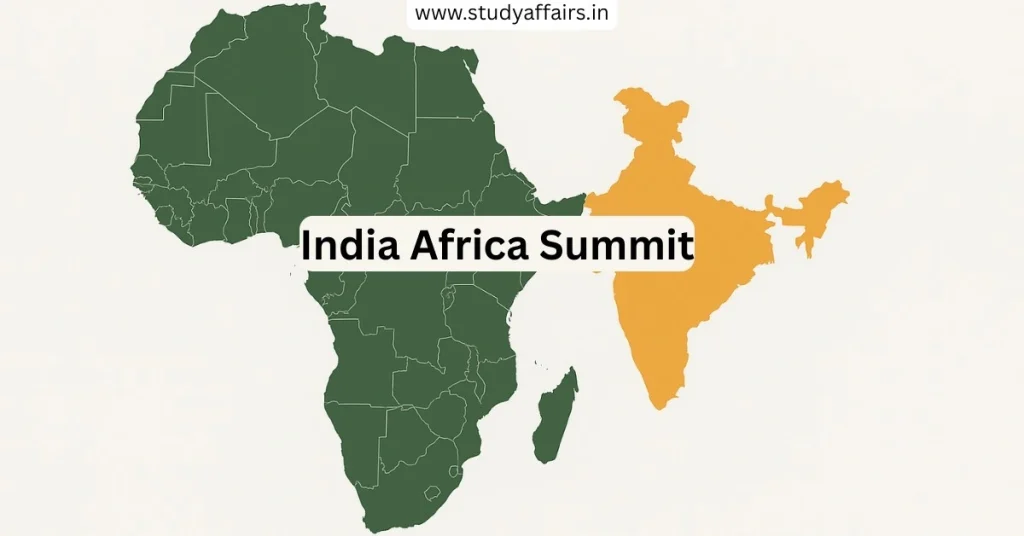
The India Africa Summit has emerged as a cornerstone of South-South cooperation, showcasing India’s commitment to building stronger political, economic, and cultural ties with Africa. As two dynamic regions with youthful populations, rich resources, and a shared history of colonial struggles, India and Africa have natural synergies.
The summit serves as a structured platform to deepen bilateral and multilateral engagements. It not only advances trade, security, and development cooperation but also positions India as a responsible global power contributing to Africa’s growth story.
Historical Context of India-Africa Relations
India’s connection with Africa dates back centuries, through ancient trade links across the Indian Ocean and cultural exchanges. Post-independence, India supported African nations in their anti-colonial struggles, aligning under the Non-Aligned Movement (NAM).
This historical solidarity laid the foundation for modern collaborations. Over the decades, India has provided capacity-building, educational scholarships, healthcare support, and developmental aid to African countries.
Importance of the India Africa Forum Summit
While India maintained individual bilateral relations with African nations, the need for an institutionalized dialogue framework became evident in the 21st century. Thus, the India Africa Forum Summit (IAFS) was launched in 2008 as a multilateral platform.
The IAFS ensures regular dialogues, policy coordination, and implementation of joint projects, enhancing mutual trust and expanding cooperation beyond trade to areas like technology, renewable energy, and security.
Evolution of the India Africa Forum Summit
First India Africa Forum Summit (2008)
Held in New Delhi, it marked a historic beginning. Leaders discussed development cooperation, agriculture, energy security, and trade promotion.
Second India Africa Forum Summit (2011)
Hosted in Addis Ababa, Ethiopia, this summit expanded on earlier commitments. It emphasized capacity building, Pan-African institutions, and regional connectivity projects.
Third India Africa Forum Summit (2015)
This was the largest gathering, with representatives from all 54 African nations participating in New Delhi. It highlighted areas such as counterterrorism, maritime security, and renewable energy collaboration.
Fourth India Africa Summit (Latest Developments)
The latest summit focuses on digital partnerships, green energy, climate resilience, and inclusive growth. It reaffirms India’s role as a reliable development partner.
Objectives of the India Africa Summit
The India Africa Summit has set multidimensional goals:
Political Cooperation
Strengthening ties through high-level visits, diplomatic dialogues, and collaboration in multilateral forums like the UN, WTO, and BRICS.
Economic Growth & Trade Expansion
Boosting bilateral trade, promoting investment in manufacturing and services, and reducing trade imbalances.
Technology Transfer & Digital Connectivity
Expanding access to digital education, fintech, and e-governance platforms through initiatives like the Pan-African e-Network.
Security & Counterterrorism Initiatives
Collaborating to combat terrorism, piracy, and cyber threats, ensuring stability across the Indian Ocean Region (IOR).
Climate Change & Sustainable Development
Promoting renewable energy (through the International Solar Alliance), climate resilience, and sustainable agriculture.
Key Outcomes of the India Africa Summit
The India Africa Summit has produced tangible results, driving collaboration across multiple domains. Some of the major outcomes include:
Trade Agreements and Investments
India has emerged as one of Africa’s top trading partners, with bilateral trade crossing $90 billion in recent years. Multiple trade agreements were signed to encourage duty-free access, enhance investment flows, and promote industrial growth.
India also invested in mining, energy, pharmaceuticals, and infrastructure, creating jobs and ensuring sustainable development.
Education, Health, and Skill Development
Through scholarships, vocational training, and capacity-building programs, India has empowered thousands of African youth. Initiatives like the Pan-African e-Network Project connected African universities and hospitals with Indian institutions.
Health initiatives include India’s role in providing generic medicines, vaccines, and telemedicine services, particularly crucial during the COVID-19 pandemic.
Infrastructure and Connectivity Projects
Indian companies and government-backed projects have contributed to roads, railways, power plants, and IT hubs in Africa. The Lines of Credit (LoC) extended by India have supported large-scale infrastructure ventures, boosting connectivity across the continent.
Energy Security and Renewable Energy
India and Africa share a commitment to clean and sustainable energy. Many African nations have joined the International Solar Alliance (ISA), co-launched by India, to promote solar power and renewable resources.
India Africa Summit UPSC Relevance
For aspirants preparing for UPSC Civil Services Examination, the India Africa Summit is a vital topic under International Relations (IR). It holds significance for both Prelims and Mains.
Importance for International Relations (IR) Paper
The summit is a case study in South-South Cooperation, diplomacy, and global governance, making it essential for General Studies Paper II (GS-II).
Key Facts and Data for Prelims
- First India Africa Forum Summit: 2008, New Delhi
- All 54 African countries participated in the 2015 summit
- India is Africa’s third-largest trading partner
- Africa is central to India’s energy security and maritime strategy
Possible UPSC Mains Questions
- “Examine the role of the India Africa Forum Summit in enhancing South-South Cooperation.”
- “Discuss the strategic significance of India’s engagement with Africa in the context of China’s growing presence.”
- “How has the India Africa Summit contributed to India’s energy and maritime security?”
Current Affairs Relevance
Since summits are held periodically, the outcomes and agreements often feature in UPSC current affairs. Candidates must keep track of the latest summit declarations and MoUs.
Challenges in India-Africa Relations
Despite the successes, several challenges hinder the full potential of India-Africa relations.
Competition from China
China’s aggressive investments, massive infrastructure projects, and high financial aid often overshadow India’s efforts. African nations sometimes perceive India’s role as secondary compared to China’s large-scale Belt and Road Initiative (BRI).
Trade Imbalances
India imports raw materials like oil and minerals from Africa but exports finished products. This imbalance risks creating resentment unless trade diversification is pursued.
Political Instability in African Nations
Coups, conflicts, and governance issues in parts of Africa impact project implementation and long-term stability of partnerships.
Logistical and Infrastructure Gaps
Maritime transport, air connectivity, and digital infrastructure remain underdeveloped, limiting India-Africa trade potential.
Future Prospects of the India Africa Forum Summit
Looking ahead, the India Africa Forum Summit has immense potential to reshape global geopolitics and drive inclusive growth.
Strengthening South-South Cooperation
India and Africa can jointly champion Global South concerns, including reforms in the UN Security Council, climate justice, and equitable trade policies.
Expanding Digital and Green Partnerships
India’s expertise in IT, fintech, and renewable energy aligns with Africa’s aspirations for a digital revolution and green transition. Joint ventures in these sectors will be critical.
Enhancing Maritime Security in the Indian Ocean
Africa’s eastern coast lies along the Indian Ocean, making collaboration on anti-piracy, naval exercises, and maritime security vital for safeguarding trade routes.
Role in a Multipolar World Order
Both India and Africa advocate for a multipolar global system where developing countries play a greater role. Their partnership is crucial in counterbalancing Western and Chinese dominance.
Conclusion: Shaping a Shared Destiny
The India Africa Summit stands as a powerful testament to the shared aspirations of two regions determined to carve a brighter, more inclusive future. With a foundation of historical solidarity and a forward-looking vision, this partnership is set to become a defining feature of the 21st century’s global order.
For India, Africa is not just a market or resource hub but a strategic partner in development, diplomacy, and global governance. Together, they embody the spirit of cooperation, resilience, and mutual progress.
FAQs on India Africa Summit
The India Africa Summit is a high-level diplomatic forum that strengthens political, economic, and cultural cooperation between India and African nations.
The first India Africa Forum Summit was held in 2008 in New Delhi.
It is a key topic under International Relations for UPSC GS-II, important for both Prelims and Mains. It reflects India’s foreign policy priorities and South-South cooperation.
The main objectives include enhancing political ties, boosting trade, sharing technology, strengthening security, and promoting sustainable development.
It has significantly boosted bilateral trade, investments, and infrastructure projects, making India one of Africa’s largest trading partners.
Future cooperation will focus on digital connectivity, renewable energy, maritime security, and global governance reforms, ensuring a stronger partnership in a multipolar world.
Click here to read this article in Hindi.