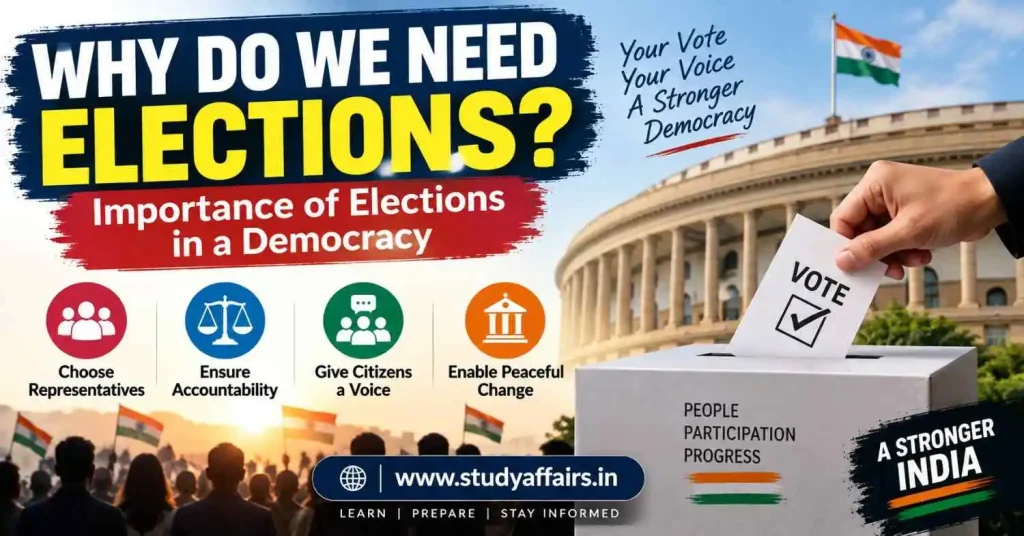
Elections are needed because people in a large democracy cannot directly take every decision about how the government should be run. Elections allow citizens to choose their representatives, participate in government, express their preferences, and replace representatives through a regular and peaceful process. In representative democracies such as India, elections are therefore an essential part of democratic government.
But elections are not only about voting. They also provide a mechanism through which citizens can influence who represents them and hold elected representatives accountable.
What Is an Election?
An election is a formal process through which people choose representatives or office-holders by voting.
In a representative democracy, citizens generally do not participate directly in every government decision. Instead, they elect representatives who make laws and take public decisions on their behalf.
The Election Commission of India describes India’s democratic system as one based on representation through elections. The Constitution gives the Election Commission responsibility for supervising, directing and controlling elections to Parliament, State Legislatures, and the offices of the President and Vice-President.
Why Do We Need Elections?
The main reason we need elections is simple:
Elections provide citizens with a regular way to choose their representatives and influence who governs them.
In a large country, it would not be practical for every citizen to participate directly in every decision of government. People therefore elect representatives to make decisions on their behalf. This is the basic idea behind representative democracy.
Elections perform several important functions.
1. Elections Help People Choose Their Representatives
One of the most important purposes of an election is to allow citizens to choose representatives.
For example, in a Lok Sabha election, voters in each Parliamentary Constituency elect a Member of Parliament (MP). That representative becomes part of the country’s law-making system.
Similarly, elections are used to choose representatives at different levels of government.
The Election Commission of India states that each Parliamentary Constituency elects one member to the Lok Sabha.
This system allows a very large population to participate in government through elected representatives.
2. Elections Allow Citizens to Choose Between Alternatives
Elections give voters an opportunity to choose between different candidates and political parties.
Candidates and parties may present different policies, programmes and priorities. Voters can consider these alternatives and cast their votes according to their preferences.
Therefore, elections are not simply a method of selecting individuals. They also provide a mechanism through which citizens can express their political preferences.
The NCERT discussion of electoral politics explains that voters make several choices through elections, including who will make laws, who will form the government and which party’s policies will guide government and law-making.
3. Elections Make Representatives Accountable
Elections create a regular connection between representatives and voters.
Elected representatives know that they will eventually have to face voters again under the applicable electoral cycle. Citizens can use elections to express their approval or dissatisfaction with the performance of representatives.
This makes accountability an important function of elections.
However, elections alone do not guarantee accountability. Accountability also depends on institutions, laws, transparency, an informed public, media, civil society and other democratic mechanisms.
4. Elections Make Peaceful Change of Government Possible
One major function of elections is to provide a constitutional and peaceful mechanism for changing governments.
If voters want a different political party or different representatives, they can express that preference through elections rather than relying on force or unconstitutional methods.
NCERT notes that India’s electoral system has enabled voters to change governments peacefully at both the State and national levels.
This peaceful transfer or continuation of political power is an important feature of representative democracy.
5. Elections Give Citizens a Role in Government
Democracy is based on the idea that citizens should have a role in determining how they are governed.
Voting is one of the most direct ways in which citizens participate in the political process.
The Election Commission of India operates the Systematic Voters’ Education and Electoral Participation (SVEEP) programme to promote voter awareness, voter literacy and participation in the electoral process.
Therefore, elections connect ordinary citizens with the formal political system.
6. Elections Provide Legitimacy to Representative Government
A government formed through an election receives its mandate through the electoral process.
This does not mean that every government decision automatically becomes correct simply because an election was held. Rather, elections provide a constitutional mechanism through which representatives are selected by voters.
For democracy to function effectively, elections also need to be conducted according to applicable laws and democratic standards.
NCERT’s discussion of election and representation emphasizes that the representative character of elections is crucial to making representative democracy effective and trustworthy.
7. Elections Encourage Political Competition
Elections create competition among candidates and political parties for public support.
Political parties may present different programmes and policies and attempt to convince voters to support them.
This competition can give voters alternatives and encourage political parties to pay attention to public concerns.
At the same time, political competition can also create challenges such as excessive campaigning, misinformation, negative campaigning or other electoral concerns. This is why democratic institutions and election laws are important.
Why Can’t Everyone Directly Take Government Decisions?
This is one of the easiest ways to understand why elections are necessary in large democracies.
Imagine a country where every citizen had to participate directly in every decision about:
- making laws
- taxation
- government spending
- national security
- education
- healthcare
- infrastructure
- foreign policy
- administration
With a very large population, direct participation in every decision would be practically impossible.
People also have different occupations, responsibilities, knowledge and interests.
Therefore, representative democracy uses elections to select people who can participate in institutions of government and make decisions on behalf of citizens.
NCERT uses this basic distinction between direct participation and representative government to explain why elections are necessary in large democracies.
What Would Happen Without Elections?
A democracy without a meaningful mechanism for choosing representatives would face a fundamental problem: how would citizens select their representatives and how could they replace them?
If representatives were selected permanently or inherited their positions, citizens would have much less direct control over who governs them.
Regular elections provide a recurring opportunity for citizens to participate in choosing representatives.
This is why periodic elections are an important feature of representative democracy.
Elections and the Principle of Equality
Elections also connect with the democratic principle of political equality.
In India’s electoral system, elections to the Lok Sabha are based on adult suffrage. Article 326 of the Constitution provides for elections to the House of the People on the basis of adult suffrage, subject to constitutional and legal provisions.
This means eligible citizens participate in choosing representatives through the electoral process.
The idea is important because political participation should not simply depend on a person’s wealth, social position or background.
Are Elections Alone Enough for Democracy?
No.
Holding an election does not automatically make a political system fully democratic.
For elections to contribute effectively to democracy, there must also be conditions that allow citizens to make meaningful choices.
These include factors such as:
- genuine electoral choice
- regular elections
- participation of eligible citizens
- equal value of votes under the electoral system
- freedom to make political choices
- proper administration of elections
- compliance with election laws
- transparent procedures
- acceptance of legitimate election results
NCERT emphasizes that electoral institutions and representative character are important to the functioning and credibility of democracy.
The Election Commission of India is constitutionally responsible for supervising and controlling the election process for Parliament and State Legislatures, which is an important institutional feature of India’s electoral system.
What Is the Role of the Election Commission of India?
The Election Commission of India (ECI) is a constitutional body responsible for administering elections in India.
According to the ECI, its constitutional responsibilities include the superintendence, direction and control of elections to Parliament, State Legislatures and the offices of the President and Vice-President.
Its work includes various aspects of election administration, such as election scheduling, polling arrangements, voter-related processes and counting-related procedures.
The ECI also conducts voter education initiatives through SVEEP.
Elections in India: A Simple Example
Suppose voters in a Parliamentary Constituency have several candidates to choose from.
The basic process can be understood like this:
Citizens → Vote → Candidate receives votes → Result is declared → Representative is elected
The elected representative then participates in the relevant legislative institution.
At a later election, voters again have the opportunity to choose among the candidates contesting that election.
This recurring process is one of the mechanisms through which representative government remains connected to citizens.
Importance of Elections: Quick Revision Table
| Importance of Elections | What It Means |
| Choose representatives | Citizens select people to represent them |
| Political choice | Voters can choose between candidates and parties |
| Accountability | Representatives remain answerable to voters |
| Participation | Citizens take part in the political process |
| Peaceful change | Governments and representatives can change through elections |
| Representation | Citizens’ interests are represented through elected institutions |
| Legitimacy | Representatives receive authority through the electoral process |
| Political competition | Candidates and parties compete for public support |
What Makes an Election Democratic?
Simply conducting an election is not enough. A democratic election should provide citizens with a meaningful opportunity to participate and make a genuine choice.
Important features include:
- Regular elections — elections should take place periodically according to the applicable constitutional and legal framework.
- Broad electoral participation — eligible citizens should have the opportunity to participate.
- Genuine choice — voters should have meaningful alternatives.
- Free choice — voters should be able to make their choices without improper coercion.
- Fair administration — electoral rules and procedures should be implemented properly.
- Equal political participation — the electoral system should operate according to applicable principles of political equality.
- Acceptance of legitimate results — the outcome should be determined through the established electoral process.
These conditions help turn elections from a mere voting exercise into an effective component of representative democracy.
Why Are Elections Important for Students?
The question “Why do we need elections?” is especially important for students studying Political Science, Civics and General Studies.
It can appear in:
- Class 9 Social Science
- CBSE and other school examinations
- State board examinations
- SSC examinations
- UPSC and State PSC preparation
- General Knowledge
- Indian Polity
- Current Affairs and civic awareness
For exam preparation, remember these core points:
Elections are needed to choose representatives, provide political choice, enable citizen participation, create accountability and allow peaceful changes in government.
Important Terms Related to Elections
Representative Democracy
A system in which citizens elect representatives who participate in government and decision-making on their behalf.
Electoral Constituency
A defined geographical area from which voters elect a representative.
Voter
An eligible person who participates in an election by casting a vote.
Election Commission of India
The constitutional body responsible for administering elections within its constitutional and legal mandate.
Electoral Roll
The official list of registered voters for an electoral constituency.
Political Representation
The process through which elected representatives act within political institutions on behalf of citizens.
FAQs About Why We Need Elections
Why do we need elections in a democracy?
We need elections because they allow citizens to choose representatives, participate in the political process, express their preferences and provide a peaceful mechanism for changing representatives or governments.
Why are elections important?
Elections are important because they provide representation, political choice, citizen participation and accountability. They also allow governments or representatives to be changed through a regular electoral process.
Why can’t people directly run the government?
In a large and complex country, it is not practical for every citizen to participate directly in every government decision. Representative democracy therefore allows citizens to elect representatives who participate in governing institutions.
How do elections make the government accountable?
Elections give citizens an opportunity to evaluate representatives and choose whether to support them again or select other candidates or parties in subsequent elections.
Are elections necessary for democracy?
Elections are a fundamental mechanism of representative democracy because they provide a way for citizens to select representatives. However, elections alone are not sufficient; democratic institutions, laws, rights and fair electoral processes are also important.
What is the main purpose of elections?
The main purpose is to provide a legitimate and regular mechanism through which citizens can choose representatives and participate in determining who governs them.
What is the role of elections in India?
Elections enable citizens to choose representatives for elected institutions and form an important part of India’s representative democratic system. The Election Commission of India administers elections within its constitutional mandate.
When was the first general election held in India?
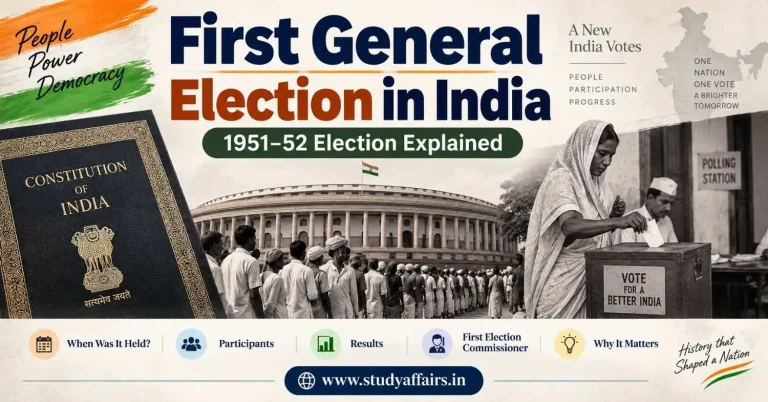
India’s first general election was held in 1951–52. The Election Commission of India records this as the country’s first general election.
Conclusion
We need elections because representative democracy requires a mechanism through which citizens can choose representatives, express political preferences and participate in determining who governs them.
Elections also provide an important means of accountability and a peaceful process for changing representatives or governments. However, an election by itself does not guarantee effective democracy. The quality of democracy also depends on institutions, laws, citizen participation and the fairness and credibility of the electoral process.
For students, the easiest way to remember the answer is:
Elections → Representation → Choice → Participation → Accountability → Peaceful change of government
One-Line Answer for Exams
We need elections because they enable citizens to choose their representatives, participate in government, hold representatives accountable and change them through a regular and peaceful democratic process.